Friday, September 10, 2010

Post Camp Wrap Up! (Part One)

Camp altar, left side
So my partner and I just returned from The F(a)eri(e) Magic(k) Gathering that we helped organize. It was a camp bringing together those interested in the intersection and cross-pollination of Feri Tradition and Radical Faerie culture and magick. He thought of the idea originally, and I jumped on board right away, as I also identify as Feri and Radical Faerie simultaneously and thought that the idea was juicy.

Camp altar, middle
We quickly assembled a team of like-minded people once we got the idea approved by the folks at Wolf Creek, where we wanted the camp to be held. Wolf Creek is a sanctuary for Radical Faeries in Wolf Creek, Oregon. They hold almost 80 acres of land and magick has been the land's primary use for decades. It is a sacred place.  We hit the ground running to make this camp happen, as by the time we got it approved, we had a mere month and a half to organize everything and promote the camp to get people interested in attending.

Camp altar, right
It was hellish, especially that last week before camp when several people had last minute problems (Mercury Retrograde, anyone?). We were in a car accident (minor, no one hurt, but the car went into the shop, causing the need for a rental); two others attending had repairs to their car costing serious cash; and the other two Feri initiates  (in addition to my partner) got so ill that they could not come. (This was stressful because as a mystery initiatory tradition, Feri must be transmitted and passed from a priest to seekers- leaving my partner alone in that part of the work.)

Ambar, our second in the kitchen!
But we persevered, got there, and in the end, it was wonderful. But it didn't start out that way. Our first day started late as people were just arriving and settling in. We did manage the meals, Feri teaching, and a ritual (starting with a ritual planning meeting after dinner). It was at that planning meeting that we all realized what we were up against: everyone on either side (and many of those spanning both sides) of the aisle had specific ideas of what ritual should be (and by extension the "meaning" of magick) and were firmly entrenched and invested in those ideas (and somewhat closed off to others).

Elfin, Kitchen Queen
It was probably premature to expect that we could design a ritual together before we got to know one another. Next year, I think the first night should be a social gathering, with dancing and revelry! So our first night's ritual was Rad Fae by default, leaving very little recognizable Feri in the mix. It left much to be desired on everyone's parts, and as an organizer I was left wondering what we had gotten ourselves into. Was it even possible to do this work? Many were mightily discouraged after day one. How to come together?

Jared and Rachel
Many strong personalities had issues that were brought to the surface with this camp. I suggested to one person that, while s/he did not want to embrace Feri as their personal thea/ology, coming to Feri class was worthwhile. It allowed us a common magic(k)al language and made sure that we all knew what one another were talking about. I suggested that s/he "play tourist" and not to take the student-teacher dynamic as an insult (which s/he was), but as a mutually agreed upon, consensual power dynamic. I told her how I also struggled: with the seemingly lackadaisical attitude of some of the other Rad Fae. How it felt like in Faespace, nothing ever happens on purpose, that they lacked discipline (in its original meaning it shares a root with "disciple"- it is a religious term) to manifest their will- rather they appear let their "woo" control them. We both had issues.

Lance
There were some interesting discussions about this topic throughout the weekend, and some of the language used on the exclusively Rad Fae side squicked me, to say the least.

First, there was the characterization of Feri as a "technology driven" practice. This term to me smacks of artificiality, machines, and soul-lessness and I was greatly bothered by it. I think what was meant that there is a thea/ology and specific tools of alchemy for the practitioner. Rad Fae does not have a unified theology, nor lots of tools (but some, which we included). To me, Feri is a religion, whereas Faerie is a culture. That statement does not make one trump the other, it just acknowledges their difference to me. But some Rad Fae think of it as a religious tradition, and felt like because there were no tools to present, that it was at a "disadvantage" in the schedule.

Melisseus
The next term that bothered me (HARD!) was the characterization of Rad Fae as an "indigenous" tradition (as opposed to Feri), which made no sense to me and smacked of cultural appropriation. (Perhaps they meant "pertaining to the self" when they used that term?) Whereas Feri has actual elements of indigenous traditions, Rad Fae is a culture that has no thea/ology to speak of, and just because one has a land to tie you to a place does not make you “indigenous” (especially since most Rad Fae are overwhelmingly white.)

Peacock and Tomkat
Days two and three had a regular, proposed schedule that included one Feri class, one Rad Fae tool (the Heart Circle) and choice of Paths that were both Feri and Faerie and simultaneously neither one. On paper, it looked balanced. Yet one Rad Fae person suggested that they felt it was too heavy on Feri, while still others thought that not enough time was available for diving in deeply to the Feri tools presented, and ended up taking that time for themselves, and not attending other things in the schedule. I am a firm believer in feelings and perceptions over paper, so both were true. In retrospect, we overscheduled the camp, not giving enough time for free time, sex, and land exploration. This needs to be built into next year's camp.

Stella Maris
We had some amazing discussions- both in Feri class (which was a facilitated open discussion about specific tools of Feri: blue fire breathing and manipulation, Iron and Pearl pentacles, grounding, the Kala rite, and soul alignment) and in Heart Circle, opening us up to one another and allowing trust to build.

Sunday was a near perfect day. Our Feri class was actually an open-ended discussion of what Gods people work with and how they do that work. It worked well, as even most Feri work with some Gods outside the Feri pantheon. We did body adornment and mask making in path work, and some amazing masks were made. The ritual that night FINALLY balanced Feri and Rad Fae in a way that we all hoped was possible but no one was sure if it would actually happen. Nimue made an appearance and possessed several people- including a Rad Fae who had never met Her before! The Peacock Angel also was there. We hooted and hollered and cackled and drummed and danced.

And how did Rowan do in this all adult gathering? Stay tuned for part two!

Wednesday, September 8, 2010

Ask Me Anything: "Channeling"

In this new feature on Witch Mom, I answer select questions from readers. There is a box to the right of my blog posts, under the "About Witch Mom" description if you would also like to ask a question. It could be about The Craft, parenting, pop culture, multi-religious education, or whatever! I cannot promise to answer each one, but I will read them!

A reader asks,
"Is it truly possible for a person to be a non-consensual trance medium or channeler?"

At a Voudou Gede in Brooklyn

Those terms (channeling, trance medium) are more new-agey than I would personally use, but the short answer is YES.

In Feri, as in many religious trads that work with spirits directly by allowing them inside us, we call the practice what it is: possession. We allow spirits and Gods to take temporary possession of our physical bodies so that we can benefit from their presence here in this world for a number of reasons.

 In my religious tradition, we "do" possessions- sometimes in a ritual context. In such a case, it is a planned part of a ritual and the "horse" (or host, or whatever you would like to call the human allowing a spirit/ God/ or being to "ride" them) is a willing participant and has prepared for such a role. We carefully negotiate with the God beforehand, letting them know the limits of what we will and will not permit when they have control of our bodies. We also carefully chose a caretaker to tend "the horse" during and after the possession. They help enforce the agreements made with the God beforehand. I have been in that role many times- I was encouraged to master that role before attempting a possession myself. As a priest-in-training, I have done both roles now several times. Both have their challenges.  As the caretaker, you need to be able to say NO to a God and be able to back it up. (Ever say no to a God before? It's um... interesting.) Gods rarely understand the physical limitations of a human body, and a horse needs an advocate sometimes.

An appropriate (consentual) type of
possession: oracular work
But to answer your question- I have personally seen, in my tradition and in other places/contexts, people that cannot control what happens to their own bodies and spirits and/or Gods take their bodies unknowingly or without consent. Yes, it does happen. This is frowned upon in my tradition, as we see ourselves equal to everything that there is, including what we call "Gods". We do not allow anything to take our life force and an unconsenting and unknown possession does just that. As a priest-in-training,  I have been trained to control my (brain and energy) states so as to either enhance a possession or to also forbid access to my person if it is not the appropriate time or place for a possession. That is why my tradition really stresses the alchemical tools we have to its students (future priests)- it builds a string spiritual container to allow us to do work like this. And gives us the ability to truly say YES and NO, to anyone- be they God or human.

Monday, September 6, 2010

Tangible Witchcraft: Devotional Mask Making (Part One)

My lovely friend elfin (who edits and writes for this blog) came over the other day to make devotional masks with us. What is a devotional mask, you ask? It is a mask that is made of and with a specific deity for the purpose of communing with them, gaining information from them, and working with them further. It can be used in a ritual context, an oracular context, or even in a trance when you are alone (with the deity). My mask is for oracular and communal work mainly, so no eye holes are needed, just nose and mouth.

The way that the process works is deceptively simple (although the materials are specific and you need assistance- you cannot do this work alone!):

1. You create a plaster mask base using quick drying plaster strips (the brand we used is called Rigid Wrap) on your own face. The book that we used to help with the nuts and bolts process was this one (to the left!). The book simplifies the process and materials needed so that you can concentrate on the trance work and embellishment part of the mask making process. I liked that a whole lot (as this is a craft project with a sacred purpose)!

You need to pick a specific deity with which you want to work and of which you want to make a mask. Often, they come to you, so you will probably not have a hard time deciding!

2. Then as your helper applies the plaster to your face, you enter a trance state (if desired, your helper can assist with that part, too) where you meet and interact with that God/dess. You have their energy and essence fill you for some time as the mask hardens on your face. The whole process for this step takes 20-30 minutes per mask.

3. When it is time for the mask to be removed, you sit up and blow the energy of the God/dess out of your body and into the mask, enlivening it and creating a link to that God/dess in the seemingly inanimate object. This will help you use the mask in devotional and ritual work with this particular God/dess. This mask is of my patroness, Lilith (as she is commonly called).

Cast of Lily's face
Be warned- this is a messy project. Wear clothes you don't mind getting messy and know that a shower afterwards is a good idea, as you are using lotions and petroleum jelly and such to keep the plaster from sticking to your skin and ripping out your eyebrows. My partner has a full beard, so you can imagine how goopy his face was for this project!

4. Once the mask is set but not completely dry, trim the edges (it's easier while it is still slightly damp).

Rowan finds a witchlet "hat"
at the craft store!
5. After you let it dry completely, the embellishment begins! Remember what information was given to you in trace, visually and energetically, and try and make that come across in how you decorate the mask. 6. A shopping trip may be in order, as the items that you assembled beforehand may not seem as appropriate after the trance. I know that I saw things that I wanted to incorporate into my mask that I did not have on hand- so off we went, looking for items!

I picked up some things at an ordinary craft store (hot glue gun and sticks, lichens and moss, colored tissue paper, Outdoor Mod Podge adhesive), some things I already had (what can I say? I am crafty!), and some things at specialty stores (shark teeth, beetle wings). I have a huge vase filled with feathers that I have been collecting from all my bird friends over the years, so that helped with this project as well.

Candle lit for God Herself
7. After the mask dried, I created sacred space for the embellishment process (which took and is taking several sessions- I am creating this mask for a camp that I am attending Labor Day weekend and it will be used both as an example for others to make their masks, and in ritual at camp.). I do all my sacred crafts in sacred space. It helps me enter trance so much easier. Often I just run with what I am getting in the moment and when I am done I am surprised at the results!

A beak added.
First thing I did to my mask was to create a beak instead of a nose. I did this with clay that air dries, although you could use more plaster strips to do the same thing if you have an armature for support. Then I  cut up some old jeans and created wing shapes to that I could embellish them with the feathers. Notice that I also taped the edges of the mask. This will be covered over in the final product.

First feather layer
Then as the clay beak dried, I worked on the wings, which will be a back to the mask- like flaps that enclose my head completely.

I used regular Elmer's glue (thickly applied) on the first set of feathers, which were more downy and meant to be a general cover.

The yellow of the beak is
also tissue paper
After the beak was dry, it was time to cover the mask. Rather than paint, I opted for colored tissue paper and Outdoor formula Modge Podge (which has the advantage for collage artists of being both a glue and a finish!). I wanted all my mask materials to be natural (as Gods are forces of nature!)- so rather than acrylic paint, I used paper. The colors I picked were symbolic- my patroness calls herself "the Lady of Blood and Moonlight" - so I picked a red the color of exposed blood. For moonlight, I chose a special silver glitter made in Germany- which is not plastic but glass. It reflects and refracts light so much more intensely than plastic and is better for the environment. After this step was done, I found that the wings were dry and I could start again on the wings, adding the heavier feathers.

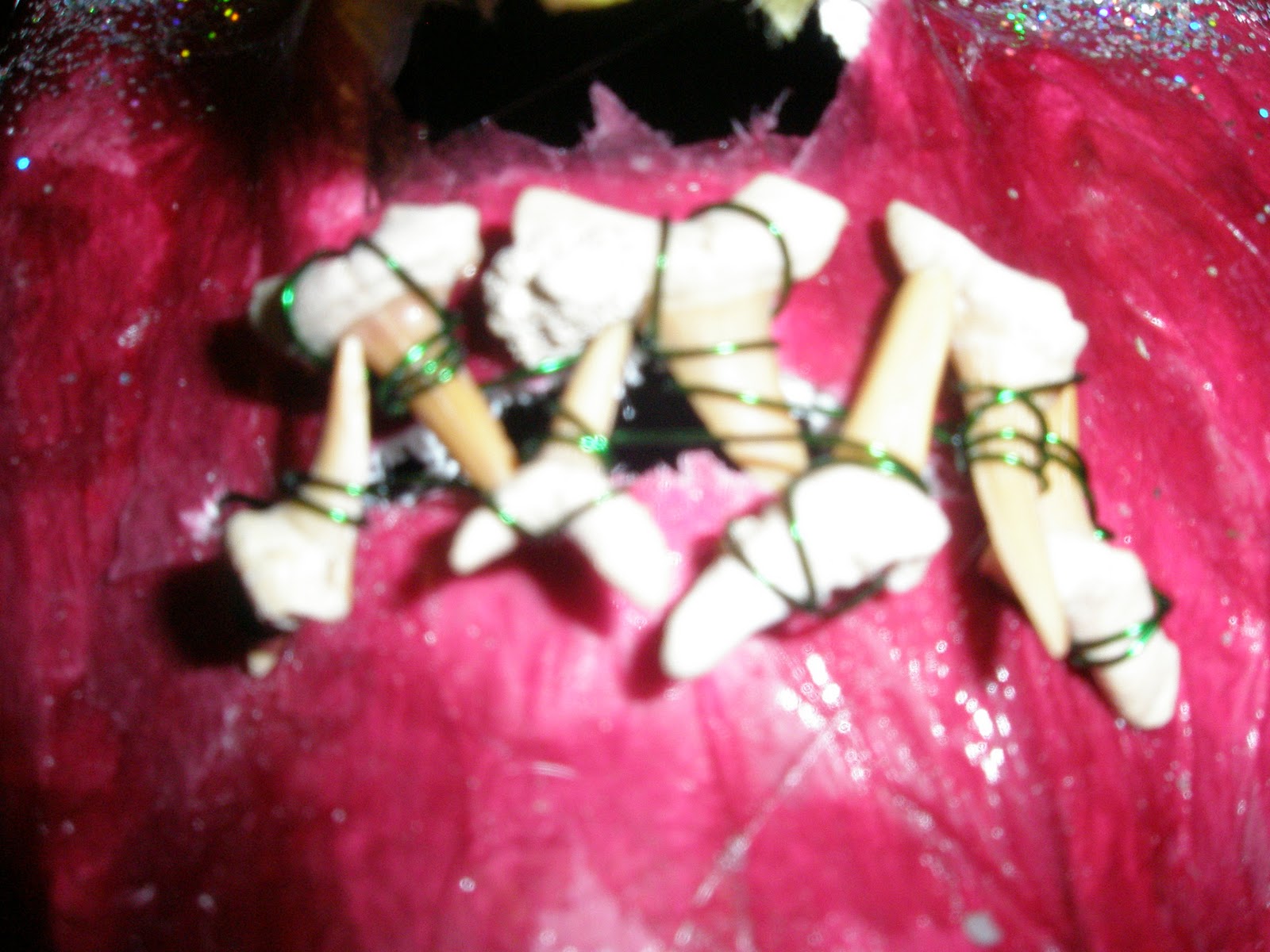
I used parrot feathers of all colors for this project as well as lichen and beetle wings on the forehead. For these steps, I used the hot glue gun and LOTS of glue. Then I was able to wire the shark's teeth into a mouth shape and attach them to the mask. Final pictures (for now) of the wings and mask:
multi-color wings
almost finished!
really bad orthodontia.
Next steps (in a future blog post): finish the edges of the wings, attach them to the back of the mask, create an elastic strap to hold the mask in place, and wearing the mask! I'll talk about helping others make theirs and using mine in a ritual context.

Hope you had as much fun reading as I did making! Stay tuned for part two!

Saturday, September 4, 2010

Finding the Flow

In my religion, we work on soul alignment a lot. It's the state of having all three of our souls working in concert with one another and the Divine. Far from a constant state, it is something you must keep doing, and something of which you must always be aware. When we are aligned, we can tap into "the flow" to do our Work and make things easier. Former Grandmaster Cora Anderson used to say that if you souls "were straight within you", you could ask for anything- and get it. One of the reasons for this is because when a witch's will is aligned with God Herself, what you ask for will be in the flow and come easily.

Finding the flow isn't always easy, especially as an adult. We get caught up in "shoulds" and deadlines and other people's expectations of us and it is then that we lose the flow. It's when we think that our created human world trumps nature and its natural patterns and cycles that we lose it. And often when we think we are in it, it is our ego telling us what we want to hear. It's easy to be fooled about flow once we lose the ability to feel it so naturally as children do.

Children naturally follow the flow- they exist in that timeless state that mystics and physicists all talk about- they innately know what flow is deep in their bones. They follow their own patterns and time lines and when we work to speed them up  or slow them down, children naturally resist. Even as babies- I keep hearing from my mama friends from birth class "The baby only takes a long nap when we have somewhere to go!" or "It takes forever to get out of the house now- I'm always late!" It's been the same here, with my child: I always hated those people who ran late, and now I am one of them. When we first brought Rowan home, we were amazed at the passage of time. The days zipped by as we cuddled in our blissful cocoon and we lost track of what day it was. My partner wrote as his Facebook status then, "Babies EAT time."

And they do eat the false measured time that we adults adhere to, that much is sure (That's their superpower!). But I think that a more accurate thing to say would be that babies refuse to pledge allegiance to such a silly concept as linear time and listen to their own inner clock- the very same ones that we were taught to ignore and distrust as children by well meaning adults.

Because after all, we don't live in that kind of world do we? I'm talking about a world where we can trust and listen to our own bodies as the final arbiter of what is right for us personally. We do not live there! Most of us base when we eat and sleep (the two main things that determine our bodies rhythms) on an outside influence- such as when we have to be at work or when someone else gives us permission to do so.

We live in such a state of disconnection to the flow as the norm, that we get angry when our children follow it! "They are being disruptive to a 'normal' and/or 'productive' life", we think to ourselves. To which Zen Master Mary Jaksch and I reply, "What could be more 'productive' than producing another human being?" What could be more normal, more mindful, than living with your child, in the present?

Photo credit: Nezdoiminoga
Our children have a lot to teach us about finding the flow, about being mindful and present. If only we would stop foisting our agendas onto them ( "Come on! You are going to be late to dance class if you don't stop playing around and get dressed!") and stop and listen for a while.

Thursday, September 2, 2010

Book Review: Dharma Family Treasures by Sandy Eastoak

This book of essays from a variety of Buddhist thinkers and practitioners is a contemplative journey. While I don't identify as a Buddhist myself, I have many friends and peers who do and I myself have a sitting practice much like Vipassana meditation. This book is written for practicing Buddhists looking for insights as to how to integrate family into spiritual practice and for Buddhists as a community to recognize parenthood as a Path in and of itself, but anyone seeking wisdom from all religions can benefit from reading this book.

It is organized into like-minded essay sections such as "Parents Practicing" (one of my favorites, actually), "The Children's Sangha", and "Honoring the Source". Essays of everyday practitioners are alongside famous Buddhists like Diane di Prima and Thich Nhat Hanh. (I actually got more out of the everyday parents, myself!) The "Parents Practicing" section talks a lot about one of my favorite topics, which is parenting as a spiritual practice. While I often read and benefit from major Buddhist thinkers like Thich Nhat Hanh, there is nothing quite like listening to another parent struggling with the same issues as you are to make for compelling reading. Reading hands-on accounts of how children were integrated (and what worked and what didn't) into mostly adult workshops, communities and retreats was interesting and enlightening (pun intended!)

One essay that pagan readers will get a lot out of is by the editor, Sandy Eastoak. In "The Wheel of the Year" she writes, "In our eclectic household, the most accessible means of sharing spiritual celebration is marking the cycle of the seasons. Although we come from Buddhist, Muslim, and Roman Catholic traditions, our holidays are borrowed from the ancient European pagans....I am not sure how to give my children Buddhism. However, in the cycle of the year, we can become aware of the mighty movements of nature and all its echoes in the largest and smallest cycles of our lives. If  Buddha is not here, where?"

I found it interesting that the Buddhist author celebrates pagan sabbats because she finds it easier to share with her children than the pujas. Besides knowing how to throw a good party, pagans revel in engaging all the senses in their rites. A good pagan sabbat includes body , mind, and spirit and is therefore easily translatable to kids.

This book is a Buddhist philosophy book with a parenting theme in the way that Parenting With Spirit was a parenting philosophy book with a spiritual theme. It has a much narrower target audience than that previous book I reviewed, but is still a worthwhile read.


Formal Rating:
Title: Dharma Family Treasures: Sharing Buddhism with Children
Author: Sandy Eastoak
Publisher: North Atlantic Books
Price: $16.95 USD 
ISBN: 1-55643-244-5

Topics Covered: Buddhism, Intentional Community, Parenting, Religion, Spirituality

Target Audience: Buddhists seeking to integrate children into their practice.
 
Witch Mom Rating: Two Hats
While pagans are not the intended audience, anyone seeking to mindfully parent will get something out of this book.